> For the complete documentation index, see [llms.txt](https://whitepaperv2.pwrlabs.io/llms.txt). Markdown versions of documentation pages are available by appending `.md` to page URLs; this page is available as [Markdown](https://whitepaperv2.pwrlabs.io/evms-on-pwr-chain.md).
# EVMs on PWR Chain
Ethereum Virtual Machines (EVMs) operate seamlessly on PWR Chain as **Verifiable Immutable Data Applications (VIDAs)**, combining the familiarity of Ethereum with PWR Chain’s scalable, decentralized infrastructure. EVM VIDAs inherit PWR Chain’s security and decentralization while maintaining full compatibility with Ethereum tooling, wallets, and tokens. Crucially, **end users interact with the EVM as if it were a standalone Layer 1 (L1) chain**—they use the EVM’s native coin (e.g., ETH, USDC) and never need to interact directly with PWR Chain or its native token ($PWR). Below, we detail how EVMs function within the PWR ecosystem and their unique advantages.
***
### Transaction Lifecycle & Flow
#### User Perspective:
To end users, the EVM on PWR Chain feels indistinguishable from a traditional L1:
1. **Initiate Action**: A user sends a transaction (e.g., token swap) via MetaMask or another EVM wallet.
2. **Pay Fees**: Fees are deducted in the EVM’s native coin (e.g., ETH), *not $PWR*.
3. **Instant Finality**: Transactions are finalized in seconds, visible on EVM block explorers.
#### Behind the Scenes:
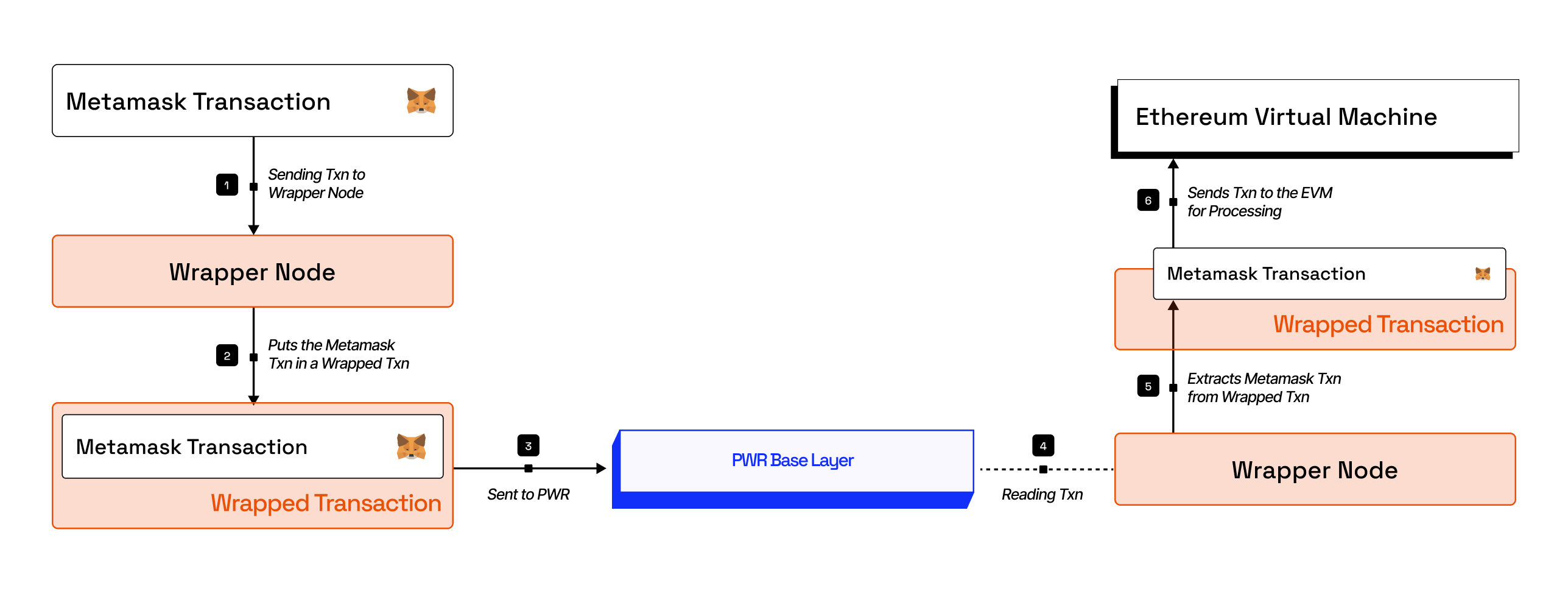
1. **User Action**: A user initiates a transaction (e.g., token swap) via an EVM-compatible wallet (e.g., MetaMask).
2. **Wrapper Node**: The transaction is routed to a **wrapper node**, which acts as an intermediary.
* Wraps the transaction into a VIDA Data Transaction format.
* Pays the fee in $PWR to include the transaction on the PWR Chain, then receives 50% of the user’s EVM fee as a reward, automatically converting EVM-native fees into $PWR and effectively shielding end users from direct interaction with the PWR Chain.
3. **PWR Base Layer**: The transaction is recorded on PWR Chain with instant finality.
4. **EVM VIDA Processing**: The EVM VIDA reads the transaction, executes the smart contract logic off-chain, and updates its state.
5. **Verification**: Anyone can rerun the EVM VIDA to validate results against PWR Chain’s immutable ledger.
***
### VIDA Execution Instance Roles: RPC & Wrapper Nodes
EVM VIDA Execution Instances can serve dual roles to enhance usability:
* **RPC Nodes**: Provide endpoints for users to query blockchain data (e.g., balances, contract states).
* **Wrapper Nodes**: Facilitate seamless interaction between EVM wallets and PWR Chain.
* Enable users to pay fees in **any cryptocurrency** (e.g., ETH, USDC).
* Automatically convert fees to $PWR and reimburse themselves from the EVM or user.
**Why Wrapper Nodes Matter**:
* Eliminate the need for users to hold $PWR or interact with the PWR Chain directly.
* Simplify onboarding for Ethereum developers and users and maintain the same user experience.
***
### Unique Features of EVMs on PWR Chain
#### 1. High Scalability
* **Average TPS**: 4,000
* **Max TPS**: 10,000
#### 2. Automated Smart Contracts
* Contracts can trigger actions autonomously (e.g., recurring payments, liquidity rebalancing) based on predefined conditions (time, events).
* Reduces reliance on centralized keepers or manual interventions.
#### 3. Fee Sponsorship
* Projects or third parties can sponsor transaction fees for users.
* Enables gasless interactions (e.g., free NFT mints, subsidized DeFi trades).
***
### FAQ
**Why do wrappers receive only 50% of the EVM fee?**\
Wrappers receive only 50% of the EVM Fee in order to protect the EVM from attacks. If the wrapper received 100% of the EVM Fee, then they can spam the EVM with high gas transactions for no cost.
**Who receives the other 50%?**\
This is customizable. It can be sent to a foundation address, charity, or burned.
---
# Agent Instructions
This documentation is published with GitBook. GitBook is the documentation platform designed so that both humans and AI agents can read, navigate, and reason over technical content effectively. Learn more at gitbook.com.
## Querying This Documentation
If you need additional information that is not directly available in this page, you can query the documentation by asking a question.
Perform an HTTP GET request on the following URL with the `ask` and `goal` query parameters:
```
GET https://whitepaperv2.pwrlabs.io/evms-on-pwr-chain.md?ask=&goal=
```
`ask` is the immediate question: it should be specific, self-contained, and written in natural language.
`goal` is what the user is ultimately trying to achieve, the reason they need the answer. Sharing it helps GitBook give you a better, more relevant answer. A goal is most helpful when it describes the outcome the user wants rather than restating the question. For example, with `ask=how do I create an API token`, a goal like `automate deployments from our CI pipeline` lets GitBook tailor the answer to that use case.
The response will contain a direct answer to the question and relevant excerpts and sources from the documentation.
Use this mechanism when the answer is not explicitly present in the current page, you need clarification or additional context, or you want to retrieve related documentation sections.